Showing posts with label event photography. Show all posts

Monday, June 8, 2009

RawShooter software and a trip to the coast

Over the weekend, while on my second visit to Santa Cruz and Capitola, I made a series of shots of classic cars parked in the city square in Capitola. The end of the pier next to the Fish and Tackle shop were a dozen or so wooden canoes painted in red and blue....a colorful sight and I clicked my shutter away. A perfect day to be spending time in the popular seaside town, temperature was in the low 70s and light breeze in the air and sailboats in the harbor. We looked at each other and concluded that a glass of wine and lunch was in order. We proceeded to a restaurant with a view of the ocean and had a sumptuous lunch, the day could not be more perfect!!!


Softwares such as Photoshop, RawShooter, Topaz and Photomatix offer the creative photographer a mirade of tools to explore the boundaries of art and photography. (Click here to read my blog on HDR photography) A new software I recently added to my photo tool box is RawShooter. A standalone freeware that has sped up my post processing workflow tremendously. RAW files are displayed as thumbnails for quick preview and one can further group them into various priority folders for post processing or to send to Recycle Bin. Post processing has never been easier and adjustments made are saved as settings under "RW Settings" folder, leaving your original RAW files untouched. There is the usual "slide ruler" adjustment on exposure, saturation, highlight, shadow, saturation, hue, color temperature, tint much like in Photoshop. When you are done post processing the image, go to the "Batch Convert" tab and add your selected photos to the list. RawShooter will then apply your post processing settings to a copy of the RAW file and store the the processed image in a "Converted" folder in tiff format. Any changes you made are made to a copy of the RAW files and not the original which remains in your folder unaltered.


What a great software and it is FREE!! I have started reviewing all my old photo RAW files, giving it a spring cleaning and freezing up some much needed space on my external photo hard drive. Anyone who shoots RAW know how tedious post processing workflow can be, I highly recommend downloading Rawshooter as an alternative to Photoshop to speed up your workflow.


Thursday, April 30, 2009

The unexpected and the results of my Holga experiments

I promised I would post shots taken with my Holga and here they are...

Firstly, I experimented with it a great deal. I put two rolls of Tmax 320 B&W through it, shot all types of scenes. Then I shot another roll of ISO 400 color Fujifilm and one ISO 800 color Fujifilm as well. Now, there is something about a crude camera box and you and getting a good shot. It is really all about composition and light (I might add here that I completely messed up my roll of ISO 800 (zilt, nadah, is all I can say about that roll - shot inside a church in dim light, I totally underexposed the roll, forgot that the least I could have done was held down the button longer). Having to adjust to seeing everything in a square format is actually a rather refreshing experience coming from 35mm - I can also see how some shots are better suited for square format than others.


The fun part:

No. 1 - there is definitely light leak and I think I know where mine is coming from. I could tape it but that would take away the element of surprise. The vignetting is actually rather nice.

No. 2 - double exposing the same frame twice is so easy that if one is not careful, that becomes second nature. Well, unless you messed up so bad that you tie a little string around your index finger to remind youself to wind the film before you click that shutter again. I have one too many shots to prove how easy that is - however to my solace, it led to rather pleasant and unique results - see below. I was trying to figure out where I had taken that strange shot and then I realized it was two shots in one....

"Dreamscape"

No. 3 - one definitely looks more inconspicious to others with this little cheap plastic camera than with a big Canon 5D and zoom lens. Theoretically, that means you are more likely to get the shots you want :) The shot below is a case in point.


Finally, as there is no way to control shutter speed but Bulb or N (is that 1/125? 1/250? that in itself is another mystery). Hence, the only way one could ever use it in dim light even with high speed film is the B setting on tripod, or hold down the shutter and time it yourself... that surely will contribute to even more unpredictable results if you get any at all...but I can see me testing that out....


Holga is cheap way to have a go at medium format. The camera is dirt cheap, the only expense is development and printing. The depth and clarity to me is still way better than similar shots on my 10D, may be I am biased.... but I think you would agree.

I did a little write up on Holgas and where you could get one cheaply... see link:
Holga's - the cult following

Also if you are looking for a decent place to host your photos, check out Smugmug FREE Trial SmugMug
or the Smugmug banner on my blog. I am hosting my photos there after researching and checking out a few options. I opted for the $59.99 unlimited gallery/photos package and I really like the fact that I have "Right Click Protect" and I could disable Printing option selectively, both are important features to me. I went for 14 day Free Trial before I took the plunge :) I would strongly recommend that.

Have fun !!

Sunday, April 5, 2009

A trip to the city...

A San Francisco travelogue

Having read that there was a camera swap meet in south San Francisco Saturday, I decided to take the BART to town which is really the best way to travel to the city. I did plenty of walking and savored the sights and sounds and spent a good hour at the swap meet. I struck up a nice conversation with an old school commercial photographer on the Mamiya C33 twin lens reflex medium format camera he was selling. We chatted, mostly with me picking his brain...and wishing the good old days had not gone away so quickly. We talked about how producing beautiful photography is still about having your techniques solidly grounded, and knowing your wares....having the eyes for the light.....and that his very first used medium format camera he bought from some guy when he first started and how he produced great pictures with it. Later that morning, I walked to the waterfront of Embarcadero. As it was a Saturday, a bustling outdoor market was in session. Crowded with locals and tourists alike, it was at times elbow to elbow walking room. I did the quick tour, and some photography and soon found myself checking out the artists selling their work under big white tents in the park away from the crowd.


"Who is this man?"

I soon struck up another long conversation with an artist whose attire was rather nomadic, who interestingly has a Chinese sounding last name but grew up in Nicaragua as I later learned (not surprisingly, as many set sail to seek work and fortune some two hundred years ago and many went to South America). A photographer who spends a few months each year outside the country in search of inspiration, his works of brightly colored weathered buildings from Cuba to Nicaragua and Rajistan first caught my attention. There was also the image of two canoes in the morning light with the Bay Bridge in the background still shrouded in fog. Then as I looked to the floor, there was a photo of a young boy cloaked in red sitting on the floor of a monastery. He was holding up a long stick, pointing to a chalk board of sentences as if to repeat after his master. On the left, soft light flooded the dim room casting a small shadow on the boy sitting cross legged on the floor. The image stopped me in my track. I lingered on and looked at it for a long time. My mind wondered back to Asia, to the people and the colorful cultures, to the villages. Sometimes an image speaks to the soul and it takes one on a journey....may be because I grew up in Asia and had traveled to many corners of Southeast Asia where life is simple and yet plentiful...and learning and acquiring knowledge is what every parent wants for their child. It was the very poignant scene that moved the photographer and caught his eyes as he took that one and only shot.

"I am the proud owner of the photo - getting it framed...in dark wood with border"

It no longer matters if I took any photo at all with my camera. The sights and sounds of the San Francisco waterfront, the hustle and bustle had suddenly taken a back seat without my knowing.

Sometimes a photograph speaks to one's soul and it is that simple. I could not help but remembering the works of Dorothea Lange, her photographs of the "Migrant Woman" and the "Man in the Bread Line". Humanity and the ability to connect and feel is such a rare commodity in today's material world, I was so very glad to know it has not completely gone away.


"The artist's gallery along the San Francisco waterfront"

As I sat on the BART train heading back to Fremont and San Jose, I was deep in my thoughts. It was a good thought. I had bought the photograph from the artist whom I had gotten to know and we made some plans for collaborative projects in the coming weeks, stay tuned......

Sunday, February 22, 2009

Who says there is no photo op when it rains (I am smiling)

You know how it is when it is your day off and you are determined to make the most of it. The weather forecast had projected rain all day long with no lull in sight for Sunday, the only day when a friend and I could do some photography - Do not put two crazy photographers together is all I can say.

It rained so hard that my Volvo 960 was hydroplaning. What started as a drizzle as we left San Jose at 7am this morning quickly turned into steady downpour on Highway 880 when we headed north towards Berkeley. Of all the days during the week mother nature could have its fun, it had to pick a Sunday.


Below are the shots in the rain, tone mapped with Photomatix, with little or no adjustment.

If there is a will, there is a way.


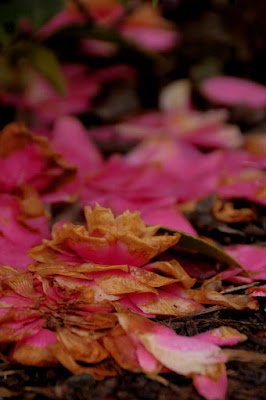
"Pink rose petals on the ground cover, it was the randomness of the pile that caught my attention"


"I was captivated by the raindrops on the elegant and yet very tiny leaves - as I moved in closer, I saw they had a nice shade of pink hue on its leaves"

Wish I could have shot it with the 100mm macro lens I did have in my bag, but that would be really risking it, getting the rain in my camera as I would have to change lens in the wet open air. You bet I am going back to that place marked F10 on the jogging path on another rainy day to shoot a couple more, and this time with my macro lens.


"Totally rained out, I took cover in my warm car, and decided if I can't beat it, why not join in the fun"

A side note, I did have to make a pit stop at the Fish and Tackle shop at the marina to get the ugliest looking fisherman's yellow raincoat. It was intended for me but it ended up being my camera's best friend - a makeshift tarp - best $7 investment.

Sunday, February 8, 2009

I am Speechless

OMG, OK, now I am speechless. Now I know how those beautiful images were created, some of them at least.

Painted archway leading to the wetland


Part II of my HDR study. I drove to Alviso, a rather charming old town 20 minutes north of San Jose proper this morning. A friend told me of the town and the weathered buildings, salt mines and cannery. There is also a tiny creek that drains 5 miles into south San Francisco Bay. I arrived around 8:15am as the sun was breaking through the dark clouds (rain expected later in the day). At the wetland were archways painted in light yellow and wooden pathways leading to each of the wildlife viewing platforms. It was magnificently beautiful, simple, yet, to a photographer, it was heaven. I had gone on an HDR mission, and so with the camera on the tripod, I shot a series of bracketed exposures and below are the toned mapped HDR images: I am blown away by what the software does to combine the tonal spectrum...... I am still in shock. Needless to say, I am sold on Photomatix, and will pay up ($99) to get the license so I can create my HDR without the Photomatix watermark and add my own watermark.

All 6 images were toned mapped using Photomatix, with little or no adjustment, all shot with camera on tripod, bracketed exposure and camera set for three consecutive shots with one single shutter click

Twigs in a small creek, Alviso marina


Painted building facade, Alviso, CA


Red brick building facade, Alvisio, CA


wild mustard field, Milpitas,CA


wild mustard flowers, Milpitas, CA


Monday, February 2, 2009

Images from my HDR study

Tripod, a sturdy one and ideally a wireless/or wired remote, no getting around it if you don't want to regret messing up an opportunity that presented itself. That is what I like about photography, every scene is unique and mother nature has a say in it. (Except in the case of a set up still life studio shot which to some extent can be repeated if you can figure out the light placement).

The Christmas scene below is a tone-mapped HDR (High Dynamic Range) image from three bracketed shots taken on a tripod during a foggy winter night. It was the lawn of the Capital building in Olympia. Without a tripod, one would not have three matching images to merge seamlessly. This one I was prepared. I had a decent tripod with me and it was worth bracing the cold night for it.

shot with tripod, long exposure, bracketed exposure


The second HDR image, that of a hillside pasture with a hint of spring was taken last weekend in San Jose. I was doing a small unplanned hike off a mountain range on a detour and did not have a tripod with me. It was 30 minutes before sunset and the hill slope just glowed with light. I set my camera to take three consecutive shots with a single shutter click and bracketed the shots (-2, 0, +2). Then I used Photomatix HDR software to map image details and shapes and merge the tonal properties. However the imperfect lines are visible if viewed at 100%.

No tripod, three consecutive shots, bracketed exposure


Then there is this last shot taken this past Fall at the Center for Wooden Boats in Seattle when on a spur of the moment, I decided to experiment with HDR. Without giving much thought to what I needed to do, I proceeded to bracket the three shots handheld (one of those stupid things I did) and thought to myself, yes, now I am going to merge them. Well, that is that, totally painfully obvious unmatched image tone mapped from three shots obviously from slightly different spot - It is sort of interesting and shows what it could have been if I had just used the tripod.

Disastrous HDR result - handheld, bracketed exposure - silly me


I remember a popular saying in the photography world:
"Beginner photographers debate over whether Nikon or Canon is a better camera, the real pros debate over which is the sturdiest tripod to have." Once lugging a good tripod with you becomes a second nature, the world you see through the lens will become that much sharper.


To see another tone mapped HDR image - of a city park shrouded in heavy fog, check out my first article on HDR Click Here

Thursday, January 22, 2009

Indoor Event Photography-Always a Challenge

Just wanted to get this link posted first as I have gotten a lot of questions on it:
If you have a limited budget and want to take better photoggraphy, where do you start?

Ok, now on Event Photography. Someone from LinkedIn who had trouble getting good shots at event photography asked me if I would recommend a few camera lens that would be more suitable and what I would do differently-a tip or two. She was using her 50mm and her 70-200mm lens handheld, and her shots had all come out "trail-marked" as she puts it.

Event photography is always challenging for photographers because one has to deal with insufficient light, distance if one can't get close to podium, any motion on stage of the subject and if there is light, the type of lighting and if so making sure the white balance is set correctly. In most cases, flash is not allowed once the event has commenced.

If one could get close to the podium, within a 6-10ft, and assuming the podium/stage is sufficiently lit then a 50mm f/1.8 or 50mm f/1.4 or a 100mm f/2 (depending on what you are shooting) on a monopod or tripod should do the job. Another thing I would do is set the camera to take at least 3 frames in succession so you don't miss any shot.

If you can't get close to the podium, and the podium is sufficiently lit, then the most suitable lens in my opinion is the Canon 100mm f/2. It is lighter than the 70-200mm f/2.8 IS (it is heavy and you would stil need a tripod collar for the white lens which would add further to the weight). Definitely still use a tripod otherwise there is no chance of getting a decent shot in an indoor event. I know of music event photographers who are extremely happy with their 100mm f/2. It is fast lens, it is not heavy, it is inconspicious as compared to the signature white lens

"Trailmarked" or "light streaks" are a result of slow shutter speed (not enough light, or camera shake, or a combination of the two). The shutter speed is not fast enough to freeze any slight motion of the subject. As a rule of thumb, you want to be shooting at shutter speed no less than the focal length of your camera lens if you don't have a tripod: so no less than 1/60 with a 50mm f/1.8 and no less than 1/125 on a 100mm f/2 lens.

If the above still doesn't give you a decent shot, then the only solution is to get upfront, where you have light and ask the subject to pose for a shot beforehand :) or ask for permission to use flash.


Canon EF 100mm f/2 USM Telephoto Lens for Canon SLR Cameras


Get it at Bhphotovideo or at or Amazon

The 100mm f/2 lens is also available for Nikon SLR. I have always preferred prime lens over my zoom lens whenever possible for the simple reason that what you give up in flexibility you get back plenty back in image quality not mentioning that prime lens are so much less expensive than comparable zoom. Using prime lens forces me to think more, compose with my feet and do photography in the ways of the Grand Masters when all they had were the old pancake lens and a 35mm or 50mm in the case of Pentax and look at those wonderful timeless photos from the Great Depression!!.